
Time:2026-05-22Reading:1320Second
After 8 years of development, foldable screen phones have blossomed, with various external and internal folding models in different horizontal and vertical shapes bringing the big screen experience into the palm of the hand.
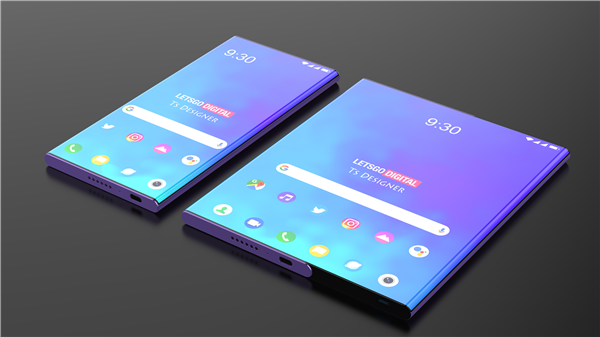
However, there is still a new form of mobile phone: scroll screen. The concept has been popular for several years, and prototypes are released every year, but there is no commercial production. Today, let's talk about how far away we are from actually being able to buy a mass-produced scroll screen phone in a store?
The Development History of Scroll Screen
At the OPPO Future Technology Conference at the end of 2020, OPPO released the "OPPO X 2021" scroll screen concept phone. Just gently slide the border, and the original 6.7-inch screen will expand to 7.4-inch under the drive of dual motors. OPPO also showcased its complex "RollMotor" powertrain and screen skeleton, proving that this is not just a CG animation, but a physical prototype with engineering feasibility.
At CES 2021, LG showcased a scroll screen phone video called "LG Rollable" and even planned a launch schedule. LG has strong technological accumulation in the field of flexible OLED, and the outside world has high expectations for its mass production. However, shortly thereafter LG announced its complete withdrawal from the smartphone market, and this scrolling screen phone was also "stillborn".
However, the LG Rollable engineering machine will be circulated in the market in the future. Some technology bloggers have opened and disassembled it after purchasing it. We will discuss the reasons why it is difficult to mass produce scroll screens in the next section.
After entering 2023, manufacturers will be more pragmatic in their thinking about scroll screens. At MWC 2023, Motorola showcased a vertical scrolling screen concept phone, the Motorola Rizr. It is very compact when not unfolded. After double clicking the button, the hidden screen on the back will slide up and become a normal proportion straight phone.
The technical barriers faced by scroll screens
Although concept machines attract attention every year, we still haven't received a truly priced mass-produced machine, mainly stuck in the following core difficulties:
Firstly, flexible screens need to be redefined. Currently, the UTG widely used in foldable screens is difficult to adapt to the curling radius of scroll screens due to its high hardness.
The hinges of foldable screens belong to passive mechanical structures, while the vast majority of scroll screens currently displayed use active mechanical structures. It is extremely challenging for manufacturers to stack motors, gear sets, sliding rails, and track like frames that support screens inside a mobile phone that is valuable for every inch of land.The motor, brush and other components occupy a huge space that originally belonged to the battery, motherboard or camera, making it difficult to control the volume and weight of scroll screen phones. If the battery capacity is significantly reduced for the sake of slimness and thinness, the power consumption of the motor extension and the power consumption of the large screen will greatly reduce the battery life of the phone.
At the same time, when the scroll screen is stretched and retracted, there must be a gap between the screen and the body. Under the current material and structure, it is difficult for a scroll screen to achieve IP68 level dust and water resistance, which is an unacceptable shortcoming for a flagship phone.
Taking all the above factors into consideration, even if mass production is forced, the cost of the entire machine will be outrageously high. In addition, there is currently no systematic supply chain for scroll screens, and the initial yield rate is also a problem. If it is pushed to the market, its price may easily exceed the 20000 or even 30000 yuan mark, which is beyond the affordability of the vast majority of consumers.
Scroll screen, still promising for the future
So, can a scrolling screen really only be a "PPT phone" forever?
Looking back at the history of foldable screens, it took about 4 to 5 years from the appearance of the first concept machines in 2018 to the true solution of hinge durability, achieving a weight close to that of straight board machines, and entering a period of large-scale popularization around 2022. The mechanical complexity and material requirements of scroll screens are one order of magnitude higher than those of folding screens, so their technological development cycle is inevitably longer.
If scroll screen smartphones want to achieve mass production, panel manufacturers need to develop higher quality flexible materials, and solid-state battery technology also needs to improve energy density to solve the battery life problem caused by insufficient internal space of scroll screens; And the accumulation of dust-proof and dustproof structures in hinges by various manufacturers also has the opportunity to be applied to the internal structure of scroll screens.
However, there is still a long way to go before the scroll screen truly solves the yield problem, reduces the cost to around 10000 yuan, and has reliability and dust and water resistance comparable to existing large folding screens, becoming a flagship product that consumers can enter with their eyes closed.